

In this post, we will show why monolithic infrastructures slow down growth and share a clear approach for private banks to turn this constraint into a competitive advantage.
A sector at a crossroads: the stability trap
Swiss private banking stands at a decisive moment.
Clients now expect hyper-personalized digital experiences, instant accessibility, and seamless global service, while regulators and regulations – such as FINMA and the EU AI Act, respectively – are tightening compliance and governance standards. At the same time, fintechs and global challengers are reshaping private banking with agile, data-driven offerings.
Yet many Swiss private banks remain constrained by legacy IT systems: rigid, costly, and slow to evolve. These systems were built as unified, monolithic architectures, integrating client management, transactions, compliance, and reporting into a single structure.

This is no longer control; it’s a cage. Fragmented data silos block a 360° client view and limit AI potential. These monolithic cores, once symbols of reliability, now hinder innovation and client responsiveness, as well as drive up maintenance costs, leading to high cost-income ratios.
To move forward, banks need not embark on a risky system overhaul. Instead, a Strategic Core Reduction (SCR) approach offers a pragmatic path: progressively reducing dependency on legacy cores, freeing data, and enabling modular, AI-driven transformation.
What is Strategic Core Reduction? The tactical shift
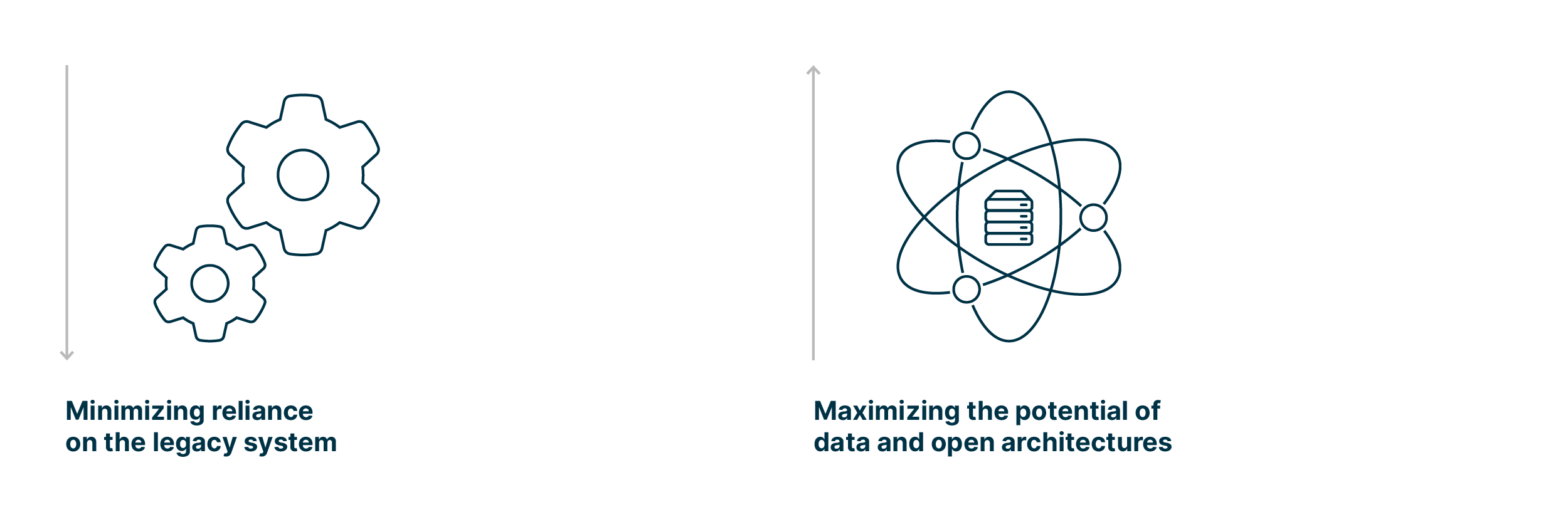
SCR is a measured modernization strategy. It focuses on minimizing reliance on the legacy system while maximizing the potential of data and open architectures.
SCR empowers banks to:
- reduce dependency on monolithic cores,
- liberate and standardize data for analytics and compliance,
- enable modular, API-based innovation, and
- balance modernization speed with client integrity and asset security.
Pathways to SCR: the blueprint
SCR unfolds through interconnected, compounding transformation pathways in an outside-in transformation model that focuses on meeting client needs.
- Client experience transformation
Enhance digital onboarding, portals, touchpoints, and advisor dashboards with AI-driven personalization and predictive insights. - Data and analytics liberation
Establish a unified data platform outside the core to power analytics, regulatory automation, and enterprise-wide AI. - Investment platform modernization
Move investment product management (e.g., product definition, pricing, and suitability) to modern, cloud-native platforms with embedded AI intelligence. - Ecosystem integration
Connect seamlessly with partners, e.g., family offices, tax advisors, and fintechs, via secure APIs and AI orchestration layers. - Multi-jurisdictional architecture
Create flexible regional setups for cross-border compliance and liquidity management, enhanced by AI monitoring.
The outside-in transformation model
This outside-in model ensures continuous, non-disruptive progress. It transforms the legacy system from the central brain into a stable, transaction-processing engine consisting of the following elements:
- Experience layer
AI-driven client experiences deliver quick, visible impact. - API and orchestration layer
Secure APIs safely expose legacy functions, enabling rapid integration with fintechs and AI systems. - Data and intelligence layer
The unified data layer allows for AI-driven compliance, risk insight, and personalization. - Selective core migration
High-value business functions move to modular platforms gradually once stability is proven.
Each layer builds on the last, turning the traditional banking stack into an intelligent, composable ecosystem.
Security: the foundation of trust
In Swiss private banking, transformation must not compromise trust. SCR embeds security and governance by design, ensuring that modernization strengthens, rather than challenges, the bank’s integrity.

Core principles include:
- End-to-end encryption and access control
- AI governance for transparency, auditability, and bias detection
- Swiss-grade cybersecurity aligned with global compliance frameworks
Trust remains the currency of private banking. SCR protects it at every level.
Building the AI-enabled private bank
Once data is made accessible and systems are modularized, AI evolves from pilot project to enterprise-wide capability by providing the following benefits:
- Predictive personalization
AI synthesizes client behavior, market conditions, and life goals to recommend tailored investment strategies and next-best actions – true advisory at scale. - AI-powered compliance
Machine learning enhances KYC/AML and suitability checks, catching anomalies that rule-based systems simply miss. It thus drastically reduces cost and risk. - Dynamic investment intelligence
AI monitors global markets, asset correlations, liquidity shifts, and macro events to identify opportunities and vulnerabilities. - Scalable automation
From document intelligence and workflow orchestration to client reporting and reconciliations, AI eliminates manual, error-prone back-office bottlenecks and frees up human experts for high-value client relationship roles.
From constraint to competitive edge
Legacy systems once ensured control. Today, they constrain growth. Swiss private banks that remain tied to them risk falling behind in innovation, compliance, and client engagement.
SCR provides a realistic, risk-managed path to modernization: freeing data, enabling AI, and delivering measurable client impact while maintaining fiduciary excellence.
SCR is not merely an IT strategy – it is a blueprint for AI-enabled, sustainable growth.
Would you like to harness AI at every stage – from intelligent automation and advanced analytics to predictive client insights?
We are happy to assist you with the transformation from legacy-bound operations into an agile, intelligent, and future-ready leader in private banking.