

<img height="1" width="1" style="display:none" src="https://www.facebook.com/tr?id=2171572209666742&amp;ev=PageView&amp;noscript=1">
asr_1

Less exposure, more resilience

Attack Surface Reduction

We identify, prioritize, and close your exposed entry points – natively integrated with Microsoft Defender, Intune, and Sentinel.

What is Attack Surface Reduction?

Attack Surface Reduction (ASR) systematically decreases the number of exploitable entry points – through discovery, risk-based prioritization, hardening, and continuous monitoring of assets, configurations, and processes.

Typical attack surfaces:

  • Digital: endpoints, apps, identities, networks, and cloud resources; patching and configuration hygiene are key
  • Physical: lack of device hardening and access control
  • Human: lack of phishing resistance, i.e., controls and awareness

Why ASR now?

Complexity and talent constraints: Modern workplace increases security complexity while specialized resources are scarce.

Most incidents stem from known issues: Speed and risk-based prioritization are decisive; rapid containment significantly changes outcomes.

Attack surface is multi-layered: It ranges from digital assets/configurations to physical components and human security awareness (social engineering). 
Our approach 

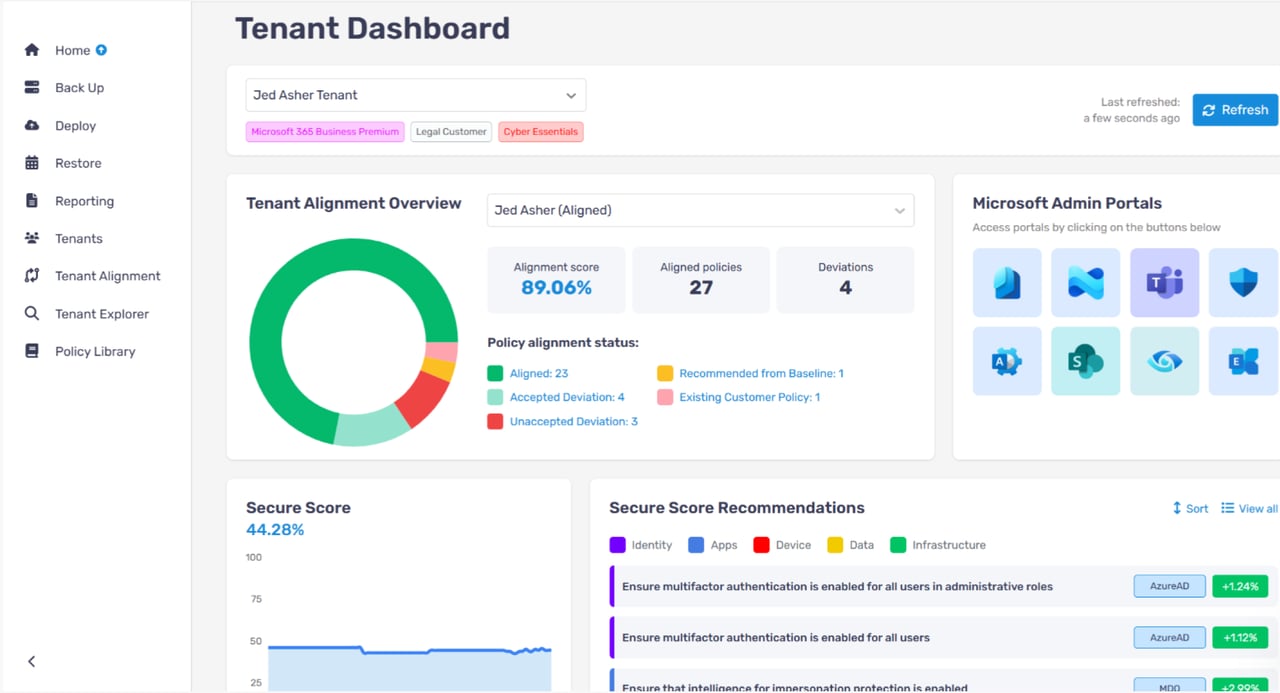
To achieve the target state, we make exposure visible, prioritize risk, harden safely – and prove it continuously.

In doing so, we follow these principles:

  1. Inventory and visibility of relevant digital resources
  2. Risk-based prioritization (TVM, Secure Score) and policy-driven hardening
  3. Fast remediation – automation plus expert actions; integrated with your Microsoft security stack
  4. Continuous monitoring and reporting with clear visualization
Download orverview
asr_2

Service

Attack surface and device security: Intune-based patching/compliance; TVM and Secure Score; AI risk scoring in Enterprise tier

Security policy management (AI-assisted): Detect overlaps/conflicts, consolidate and maintain role-based baselines (PAW, BYOD-MAM, Executive, Frontline, Kiosk/Shared, Developer, VDI, External). Release flow: Build → Test → Monitor → Release

Threat detection (XDR) and incident response: From baseline detections to fully automated playbooks (EDR isolation, live response, timeline forensics)

Darknet monitoring: From identity-based checks to continuous darknet feeds

Reporting and dashboards: Standard → Power BI → executive dashboards with risk/attack simulation

Regulatory support (e.g., FINMA): From initial notifications to full documentation

Packages

Licensing note: Depending on the package chosen, Microsoft Business Premium, Business Premium and E5 Security, or Microsoft 365 E5 will be required.

asr_6

Basic

Intune patching/compliance, baseline XDR, standard reports, support during office hours

asr_4_newnew

Standard

TVM and Secure Score, advanced hunting and alert handling, compliance views, Power BI dashboards, identity-based darknet checks

asr_5

Enterprise

AI risk evaluation, custom detections, automated response (Sentinel playbooks), executive reporting, full Purview (labels and DLP), regulatory mapping

asr_3

How we work

5-Step flow

  1. Assessment and inventory – We map your exposure and critical assets.
  2. Prioritization and plan – TVM/Secure Score guided; quick wins and baseline roadmap
  3. Policy baselines and hardening – by device/user roles (e.g., PAW, BYOD-MAM, Kiosk)
  4. Pilot → staged rollout – We minimize side effects and use audit/monitor modes before enforcement.
  5. Continuous monitoring and reporting – We provide evidence of effectiveness and iterate improvements.

Outcomes you can expect

  • Faster risk reduction via automation plus targeted expert action
  • Proven hardening through TVM/Secure Score and executive-ready dashboards
  • Policy sanity, i.e., less drift, fewer conflicts, clearer baselines per role
  • Regulatory readiness, i.e., accelerated documentation and notifications (e.g., FINMA)

Microsoft integrations

  • Defender for Endpoint / XDR (detections, EDR isolation, live response)
  • Intune (update compliance, configuration, and role baselines)
  • Sentinel (automation/playbooks, investigation, forensics)
  • Purview (sensitivity labels, DLP)

Best practices we follow

  • Audit first, enforce second – We monitor impact before tightening controls.
  • Routine patching and configuration hygiene – We reduce known exposures.
  • Security awareness – We ensure technical controls and raise awareness.

FAQ

ASR vs. ASM/EASM – What is the difference?

ASM/EASM focuses on visibility of exposure (often externally), while ASR focuses on hardening and reduction, closing and controlling those exposures. We combine visibility with prioritized remediation.

What Microsoft licenses are required?

Depending on the package chosen: Business Premium, Business Premium and E5 Security, or Microsoft 365 E5.

Is BYOD supported?

Yes, BYOD is supported via role-based baselines (e.g., BYOD-MAM) and strict separation of corporate vs. private data.