

Switzerland is no longer in the experimentation phase when it comes to digital assets. It is already one of the most advanced banking markets in the world in this field.
According to the March 2026 Digital Asset Banking Report for Switzerland published by the Crypto Valley Association, Switzerland leads globally with 20 banks offering crypto services, ahead of the US with 15 and Germany with 12. Digital asset adoption is no longer limited to crypto-native players. Names such as ZKB, PostFinance, Julius Baer, LUKB, Swissquote, Sygnum Bank, and others are already part of the Swiss landscape.
How did Switzerland become a digital asset banking pioneer?
That leadership did not happen by accident. Switzerland moved early, combined openness to innovation with legal clarity, and built an ecosystem that allowed banks to explore digital assets before many other markets were ready to do so. FINMA published its ICO (initial coin offerings) guidelines in 2018, granted banking licences in 2019 to the first pure-play blockchain service providers SEBA (now AMINA) and Sygnum, and the DLT (distributed ledger technology) Act fully entered into force on 1 August 2021, creating additional legal certainty for tokenized assets and trading venues.

Is it too late now to enter the market?
For banks and financial institutions that are still not active in this field, the real question is no longer whether digital assets matter. The question is when to move. And despite what some latecomers may think, it is not too late. In many ways, this is actually a very good time to enter the market: The ecosystem is deeper, providers are more mature, the regulatory perimeter is better understood, and the first wave of institutions has already absorbed part of the learning curve.
So where should a bank start?
The first question is straightforward: Should I buy or build the necessary infrastructure?
Buy: the fast lane
Advantages of buying
For institutions that want to move quickly, buying is often the obvious first step. The Swiss market already offers a strong ecosystem of B2B digital asset providers, including players such as Sygnum Bank and Crypto Finance AG. This means a bank does not have to assemble everything from scratch to launch a credible digital asset offering.
The case for buying is simple:
-
faster time to market
-
proven institutional-grade building blocks
-
modular services that can reduce execution risk
-
less internal complexity at the beginning
For many banks, that is exactly what they need: a practical way to launch an initial offer built around custody and trading, learn from real client demand, and avoid turning the first phase into a multi-year transformation program.
But buying also has limits.
Disadvantages of buying
Over time, cost savings can become less attractive than owning more of the stack yourself. More importantly, a fully outsourced setup can reduce differentiation. If your digital asset offering looks exactly like everybody else’s, it becomes harder to turn it into a real strategic advantage. There is also the relationship question: Depending on the provider, you may be introducing another financial institution or infrastructure player into a part of your value chain that you may eventually want to control more directly.
|
Advantages |
Disadvantages |
|
|
|
Buy |
|
|
|
|
Build |
|
|
|
|
|
|
||
Build: the strategic route
Building your own digital asset infrastructure is a very different decision.
Advantages of building
Building usually makes sense when a bank has already concluded that digital assets are not just a side offer, but a strategic capability. In that case, building is about more than technology. It is about internalization: of knowledge, control, governance, and future optionality.
The advantages are compelling:
-
higher long-term savings at scale
-
deeper control over the architecture and roadmap
-
tighter integration with the bank’s own processes and security model
-
stronger internal knowledge of digital assets
Disadvantages of building
Building only works if the institution is prepared to invest seriously – not just in budget, but also in time, governance, talent, integration, and operating model design. A digital asset setup is not a demo environment. It becomes part of the bank’s real infrastructure, with real client assets, real operational risk, and real regulatory expectations. This is where many institutions underestimate the effort. The technical stack may be more accessible than it was a few years ago, but that does not mean you can neglect disciplined engineering and security hardening.
For some institutions, the most pragmatic route is to buy first to enter the market quickly, then build selectively once the business case is proven.
Start with custody, the foundational layer of your digital asset architecture
The single most important technology building block for a bank entering digital assets is custody.
Digital asset security – literally a key element
The analogy is simple: When a traditional bank is established, one of its first investments is the vault. Not because the vault is the entire bank, but because without it there is no safe way to protect value. In digital asset banking, custody plays the same role. It is the digital vault that protects private keys, and private keys are what ultimately controls access to digital assets.
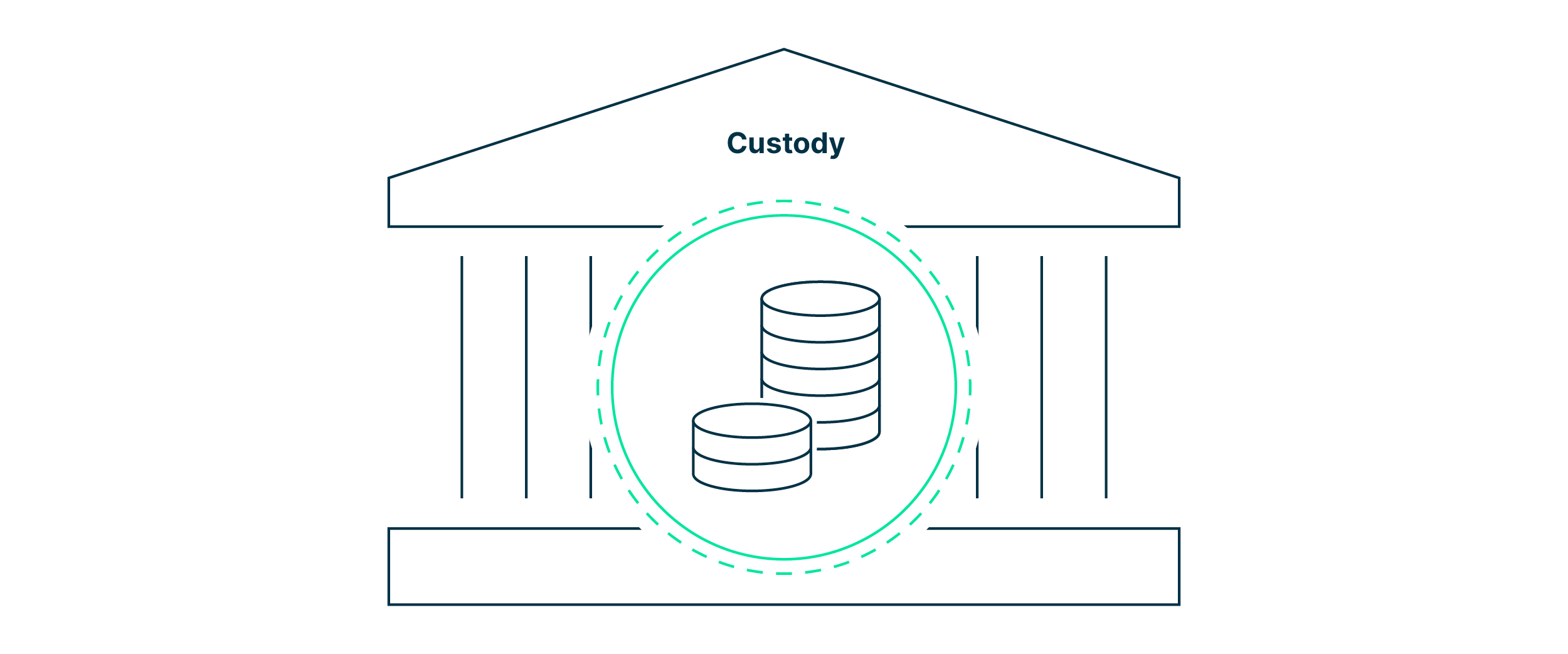
Custody is not just a technology preference anymore. It is now clearly a supervisory topic. In January 2026, FINMA published guidance specifically on the risks associated with the custody of crypto-based assets and on the requirements institutions must meet to limit those risks. FINMA explicitly says it is seeing growing interest in crypto-based assets and related services in the Swiss financial market.
That is why custody and digital asset security should be the first focus topics.
HSM vs. MPC: less religion, more strategy
Once a bank seriously considers custody, one debate comes up very quickly: HSM (hardware security module) or MPC (multi-party computation)?
Too often, this discussion is framed almost like a religious argument: hardware versus software. One side emphasizes stronger isolation and familiar security controls, the other greater flexibility and operational agility.
These are the questions that matter:
- Will your first use case be mostly long-term storage or active trading flows?
- How many people need to be involved in approvals?
- What segregation of duties do you need?
- How will recovery work in a crisis?
- How much flexibility do you need for future products?
- Do you want one custody model or several?
More and more institutions are realizing that HSM and MPC do not always have to be treated as mutually exclusive. A multi-custody approach can make a lot of sense: one setup for deep cold storage, another for more active transaction environments, and clear governance between the two. In other words, this is not a theological choice. It is an architectural decision.
What banks should analyze before choosing a custody setup
| Why is it important? | |
| Security and governance |
|
| Integration |
|
| Product roadmap |
|
| Exit options |
|
Whatever model you choose – i.e., buy or build and/or HSM or MPC –, there are a few things that deserve close attention from the start:
-
Security and governance
Custody is the most sensitive part of the digital asset stack. It protects the keys that control client assets and the institution’s own positions. That makes key ceremonies, access control, approval workflows, auditability, recovery processes, and incident response planning absolutely critical. - Integration
A custody solution can work in standalone mode at the beginning. But that should be a phase, not the end state. Over time, it needs to connect with the rest of the bank: booking and reconciliation, compliance and AML processes, reporting, client channels, and often the core banking environment. Real value is created only when processes become reliable and repeatable, not when they remain manual forever. - Product roadmap
A credible market entry usually starts with at least custody and trading. From there, the roadmap may expand to staking, lending, tokenization, or collateral workflows. The architecture should support that journey from day one. - Exit options
This point is often forgotten. If you buy first, can you migrate later without redoing everything? Can data, workflows, and controls be transferred to a future in-house model? A good first choice should not lock you out of your second one.
Turning strategy into a competitive advantage
Digital assets are becoming part of the mainstream financial infrastructure in Switzerland, as the market is moving from isolated initiatives to broader institutional adoption. The institutions that will benefit most are not necessarily the ones that moved first. They are the ones making the right technology choices now, with enough speed to capture the opportunity and enough discipline to build something durable.
Would you like to discuss how your institution can best approach digital asset banking?


Jérôme Bailly
Business Development Manager, President of the Board of Crypto Valley Association

jerome.bailly@adnovum.ch
Glossary
|
|
|
| Crypto Valley Association (CVA) | A Swiss-based independent, non-governmental association established in 2017, the Crypto Valley Association works to drive growth, collaboration, and integrity across the global blockchain economy. |
| Digital asset | Financial instruments or representations of value stored and traded securely on blockchain or distributed ledger technology. |
| Digital asset custody | A digital vault for the secure storage and management of digital assets, namely cryptographic private keys |
| DLT Act | The DLT Act, which came into force on 1 August 2021, allows granting licenses for DLT trading systems. These are financial market infrastructures for DLT-based securities that can admit not only financial intermediaries but also other companies and individuals to trade. |
| FINMA | The Swiss government body responsible for the supervision of banks, insurance companies, stock exchanges, securities dealers, and other financial intermediaries in Switzerland. |
| Hardware security module (HSM) | A tamper-resistant physical device designed to securely generate, store, and use cryptographic keys and to perform sensitive cryptographic operations, such as encryption/decryption. |
| ICO guidelines | The guidelines on initial coin offerings (ICO) describe how FINMA intends to apply financial market legislation in handling enquiries from ICO organizers. They also define the information FINMA requires to deal with such enquiries and the principles upon which its responses are based. |
| Multi-party computation (MPC) | In the context of digital asset custody, MPC is often used to split control of a private key across multiple parties/devices so that no single party ever holds the full key, yet they can still authorize transactions together. |
| Tokenization | The process of representing an asset or right as a digital token on a blockchain or other distributed ledger, so it can be issued, held, transferred, and managed digitally. |
|
|
|