
<img height="1" width="1" style="display:none" src="https://www.facebook.com/tr?id=2171572209666742&amp;ev=PageView&amp;noscript=1">
bottom-view-modern-buildings_square

Insurance and InsurTech

Quietly Modernized. Ready for the Future.

How a leading insurance company, together with Adnovum, transformed its mission-critical mainframe landscape into a resilient, event-driven architecture, one step at a time.

From Reliable Backbone to Future-Ready Platform


For decades, the mainframe served as the stable foundation of a leading insurance company. It reliably supported mission-critical business processes and ensured operational continuity.
As customer expectations evolved, digital channels multiplied, and the pace of innovation accelerated, a new challenge emerged. The question was no longer whether the existing systems were stable enough, but whether they could adapt quickly enough to changing business needs.
Together with Adnovum, the company chose a different path. Instead of pursuing a costly and high-risk replacement program, it adopted a gradual modernization strategy.
By introducing an event-driven architecture, critical business processes and data were systematically exposed beyond the mainframe and connected to a modern application landscape. This approach enabled innovation without disrupting existing operations.
Step by step, a future-ready platform emerged, combining the strengths of both worlds: the reliability and security of proven core systems with the flexibility and speed of modern digital services.
No big-bang replacement. No unnecessary risk. Just a clear path toward a technology foundation built for the decades ahead.
Talk to an expert

The Starting Point

For many years, the company's mainframe environment formed the technological backbone of its insurance operations. Core business processes such as policy administration, underwriting, and claims handling ran reliably on proven systems.
At the same time, growing demands for agility, enhanced digital customer experiences, and the integration of new applications increased pressure on the existing architecture. What had once been a competitive advantage was gradually becoming a constraint on innovation and responsiveness.

The Challenge

The challenge was not a lack of stability. The mainframe reliably supported the company’s mission-critical insurance processes. But its tightly coupled architecture made it increasingly difficult to integrate new applications, use business data across systems, and respond quickly to changing customer and market needs.
A complete replacement would have introduced significant cost, complexity, and operational risk. The company therefore needed a way to create greater flexibility around its core systems while preserving the reliability, security, and continuity of the existing insurance business.

The Solution

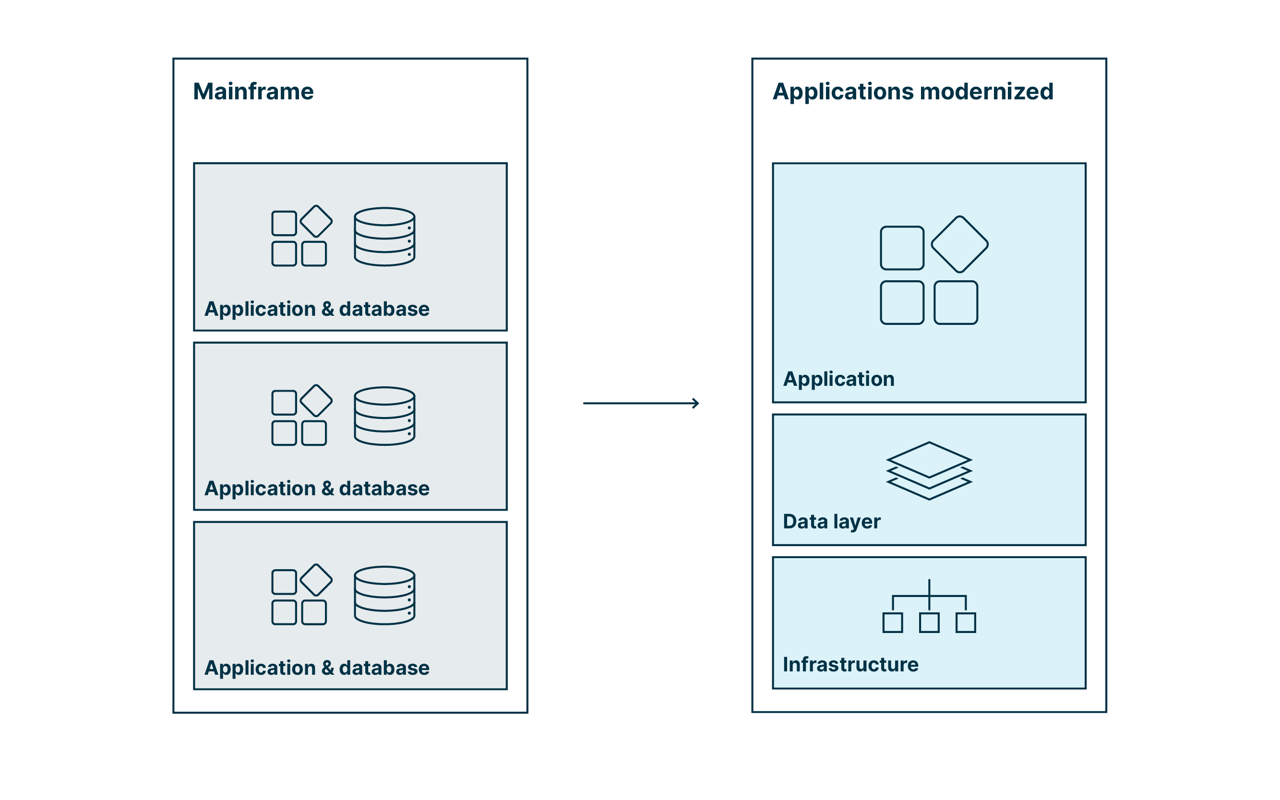
Together with Adnovum, the company introduced an event-driven architecture that gradually connected its mainframe environment to modern applications and digital services. This incremental approach enabled modernization to happen in controlled steps, reducing risk while establishing a scalable foundation for future innovation.

The Outcome

Today, the company benefits from a technology landscape that balances stability and adaptability. Proven core systems continue to support critical insurance processes, while the new architecture provides the flexibility to integrate future services, accelerate innovation, and continuously evolve the application landscape in line with changing business needs. 

Key Takeaway

Sustainable transformation does not necessarily require replacing existing systems. In many cases, the greater opportunity lies in strategically decoupling proven core systems and gradually integrating them into modern architectures.
By combining technological stability with controlled modernization, organizations can accelerate innovation while minimizing business risk. This approach enables companies to evolve their technology landscape without sacrificing the reliability and resilience that their business depends on.

legacy_modernization_en

Legacy modernization is not about replacing technology. It is about creating a resilient foundation for more adaptable, efficient, and future-ready business operations. 

Modernize Without Putting Your Core Business at Risk

Let's explore how your existing application landscape can become more flexible, transparent, and ready for the future.